
Stop Coding. Start Orchestrating.
Emergence of AI made the fundamental assumption underlying every software development methodology obsolete.


The Hidden Assumption That Broke
Every software development methodology and framework (Agile, DevOps, SAFe, LESS, etc.) shares one unspoken premise: only humans possess intelligence. This assumption shaped everything:
Version control: Designed for human-readable diffs
Code reviews: Human experts validate human output
Testing frameworks: Humans write tests for human-written code
CI/CD pipelines: Automate repetitive tasks humans find boring
Project management: Coordinate human cognitive bandwidth
Documentation: Explain human decisions to other humans
We built an entire ecosystem optimized for scarce intelligence. With the emergence of AI, human lost monopoly on intelligence.
The Impedance Mismatch
Adding AI to traditional SDLC creates fundamental contradictions:
Traditional SDLC Assumes:
Sequential reasoning: Humans think step-by-step
Persistent artifacts: Code files store accumulated knowledge
Deterministic execution: Same input → same output
Manual coordination: Humans synchronize via meetings
Error as failure: Bugs indicate process breakdown
AI Agents Deliver:
Parallel exploration: Thousands of solution paths simultaneously
Ephemeral generation: Code as temporary knowledge rendering
Probabilistic outcomes: Same input → distribution of solutions
Self-coordination: Agents negotiate directly
Error as information: Failures guide system evolution
Result: more bugs, crazy code churn, and overwhelmed developers rejecting the technology. Meanwhile, emerging startup labs and bold SMBs implementing AI-native SDLC processes report 10x+ faster deployment cycles and unprecedented technology-driven business growth. The common difference? They rebuilt processes for intelligence abundance rather than forcing AI through human-centric pipelines.
Anatomy of AI-First SDLC
Building SDLC from scratch with intelligence abundance changes everything:
Layer 1: Knowledge Primacy
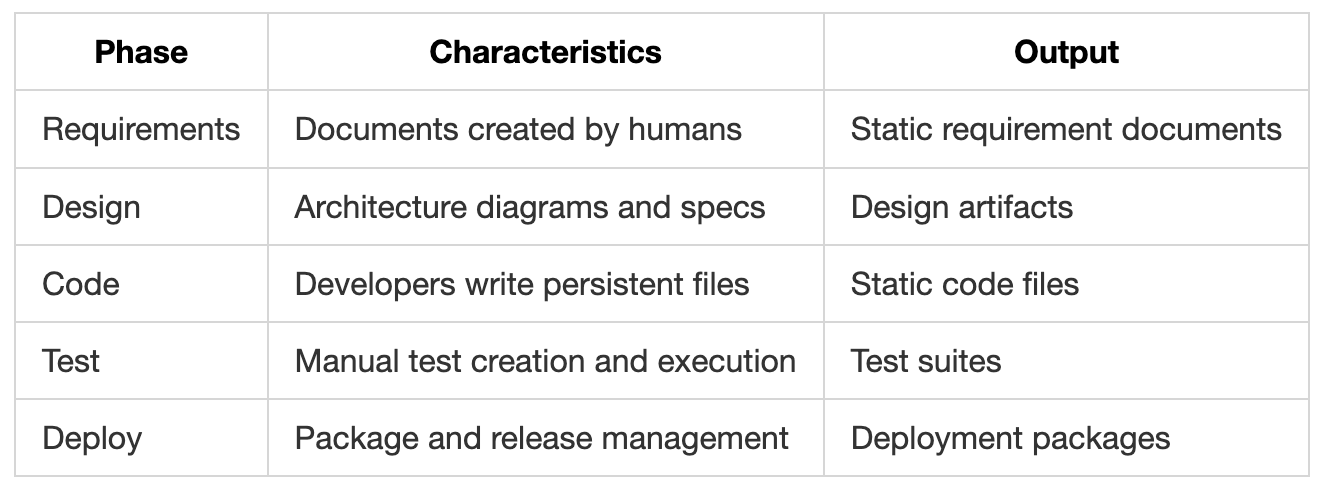
Traditional
Requirements → Design → Code → Test → Deploy
AI-First
Knowledge Graph → Agent Orchestration → Ephemeral Execution → Continuous Validation
Traditional SDLC
AI-First SDLC
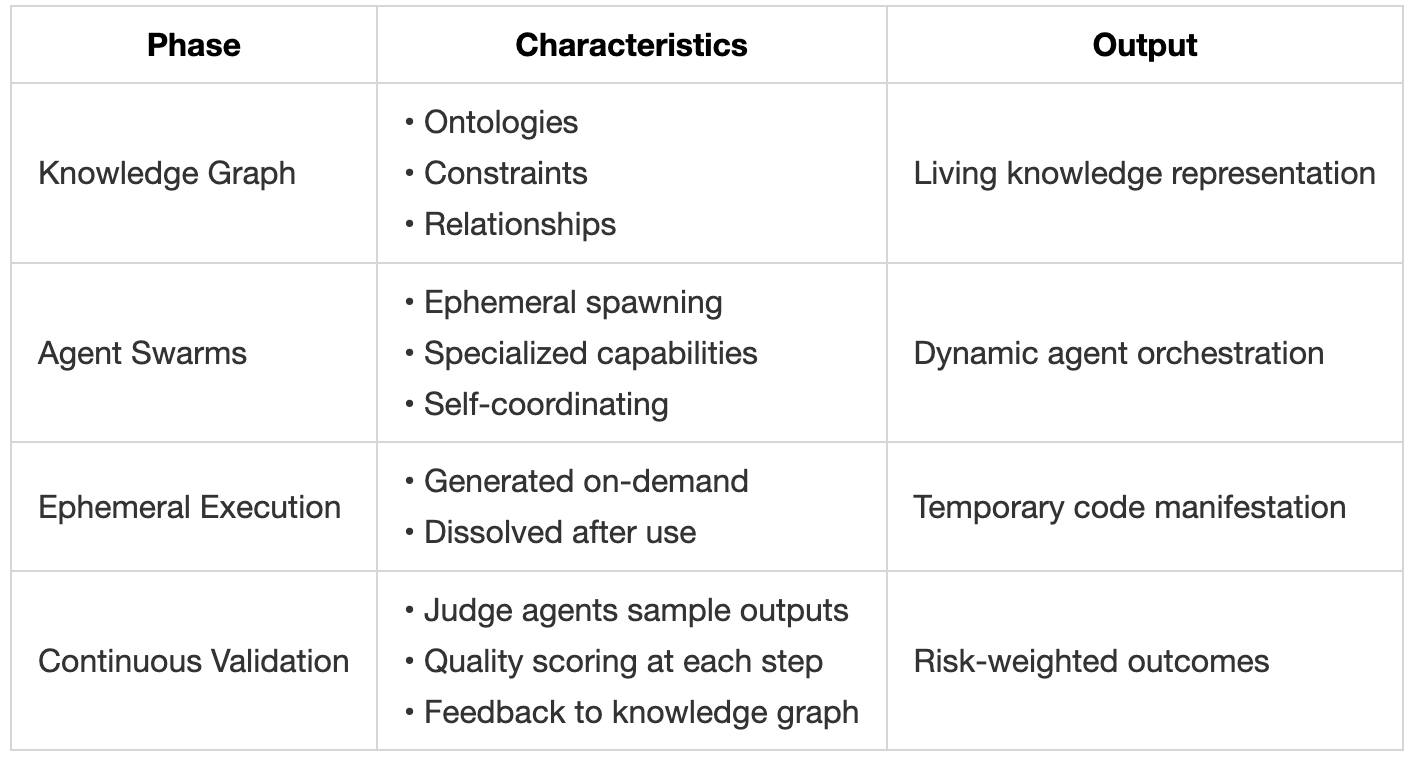
Key Difference: Traditional SDLC produces persistent artifacts at each stage. AI-First SDLC maintains only the knowledge graph as persistent truth, with everything else generated ephemerally as needed.
Layer 2: Tool Architecture Inversion
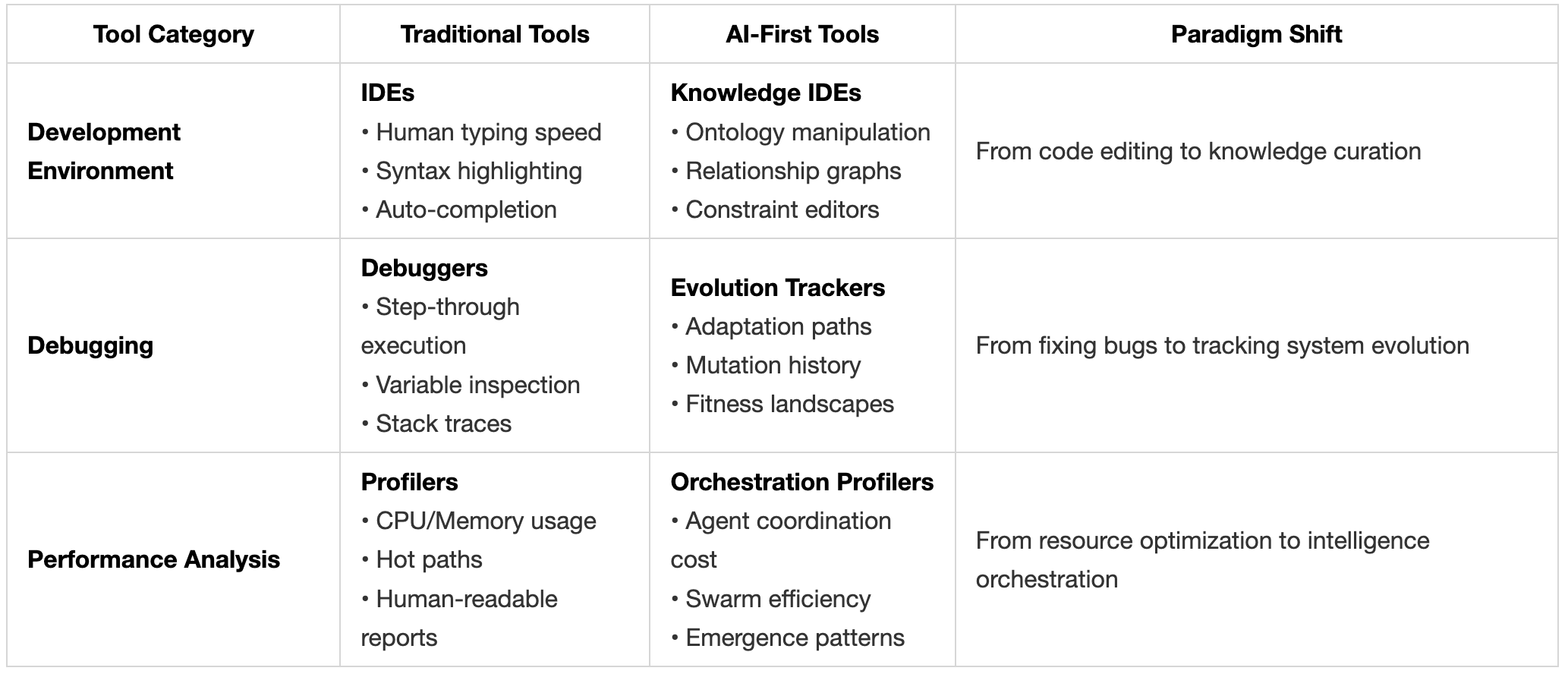
Core Transformation: Traditional tools optimize for human developers writing and debugging code. AI-First tools optimize for managing knowledge graphs and orchestrating agent swarms.
Leading methodologies and frameworks (Claude-Flow, LangChain, CrewAI, AutoGen, LlamaIndex) already provide many of these capabilities.
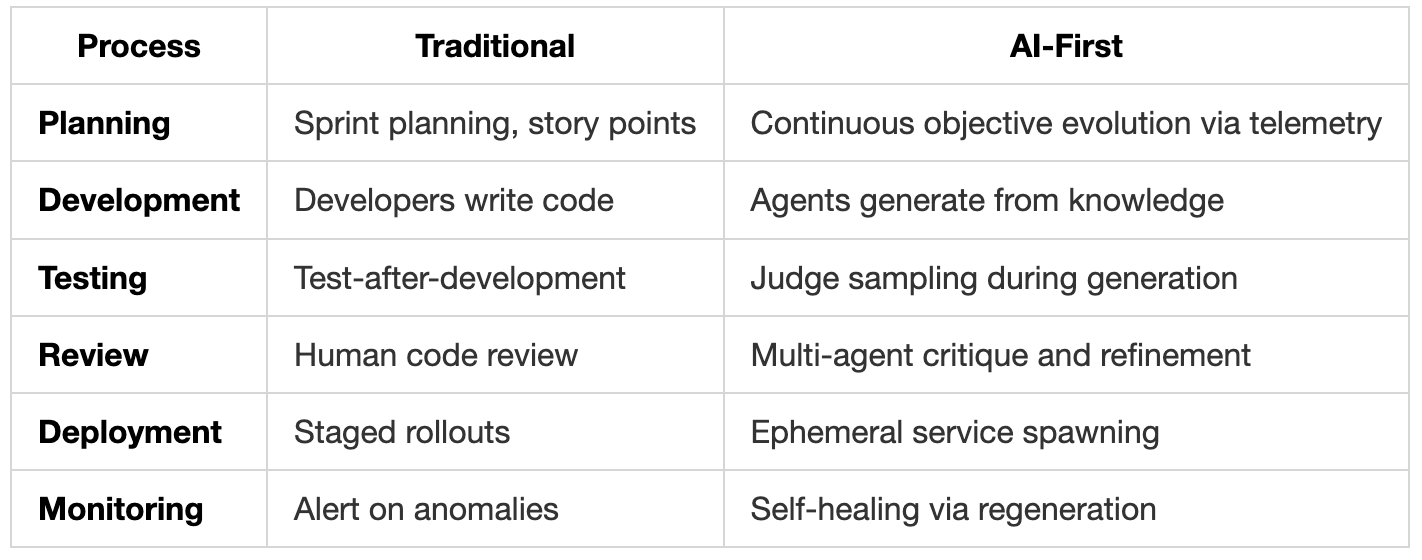
Layer 3: Process Redefinition
Layer 4: Risk-Weighted Governance
Traditional SDLC treats all changes as equally risky. Ideal AI-First SDLC would implement mathematical risk stratification with Judge agents continuously sampling outputs:
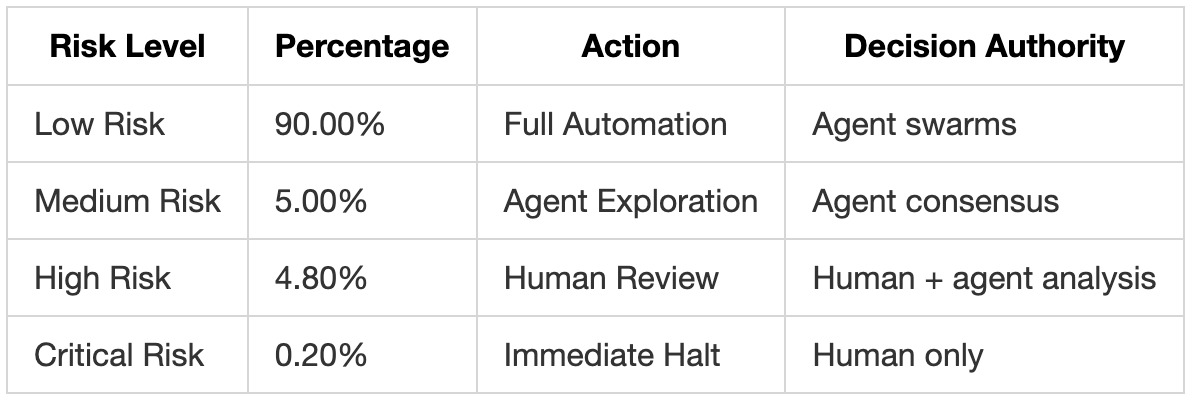
Human attention becomes surgical, not supervisory.
The New Primitives
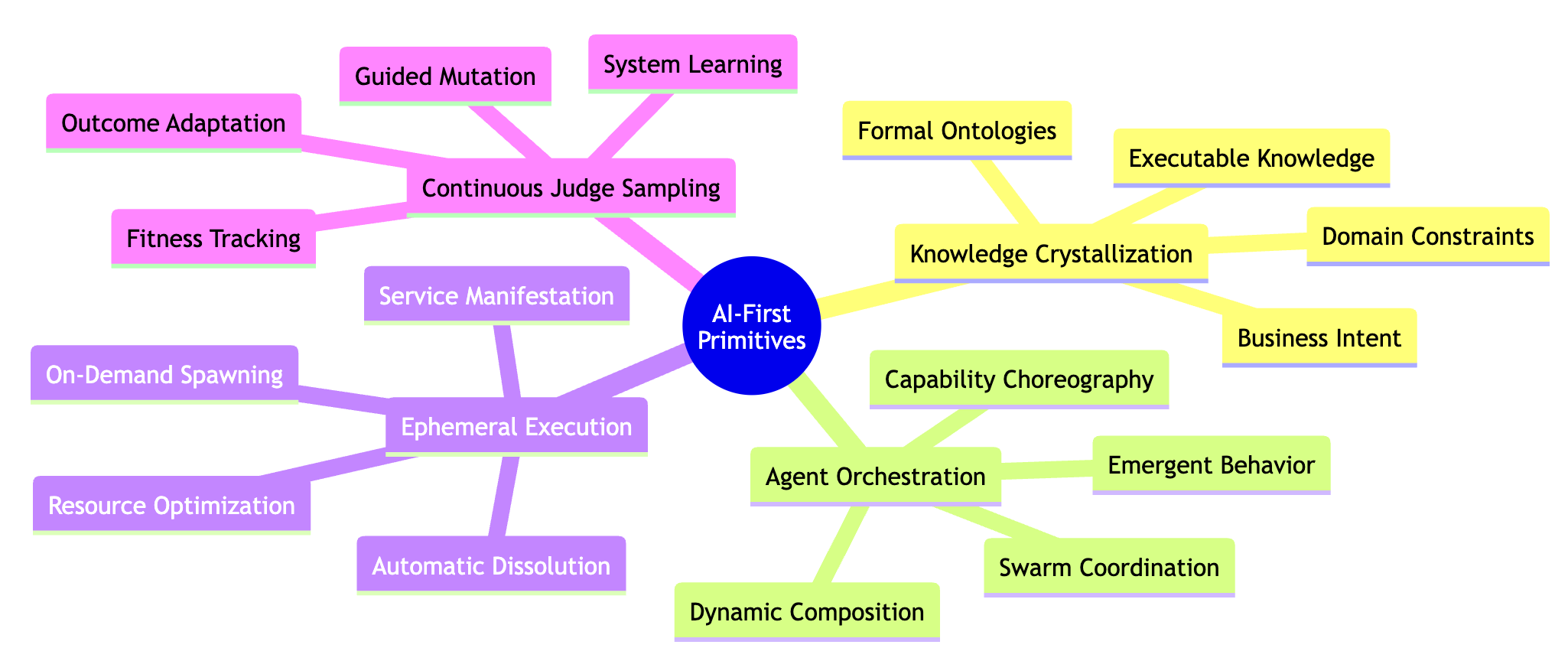
AI-First SDLC requires new fundamental operations:
What Dies, What Emerges
Obsolete Concepts:
"Technical debt" (code regenerates fresh)
"Code ownership" (knowledge owned, code ephemeral)
"Deployment windows" (continuous manifestation)
"Version control" (knowledge graphs version themselves)
"Bug tracking" (systems self-correct)
Emergent Concepts:
Knowledge debt (incomplete ontologies)
Orchestration ownership (who governs which agents)
Manifestation patterns (how services spawn)
Ontology evolution (knowledge graph versioning)
Evolution tracking (system adaptation paths)
Conclusion
Traditional SDLC optimizes for a world that no longer exists. Every methodology (Agile, DevOps, SAFe) assumes intelligence scarcity. That assumption is now false.
Organizations face a choice:
Force-fit AI into human-centric processes
Rebuild processes around intelligence abundance
The first path leads to expensive failures. The second requires a solid AI strategy and early adopter's mindset in continuously refining emerging Agentic Frameworks.
Building Your AI-First SDLC
Start here:
Map your implicit knowledge: What do your senior engineers know that isn't written anywhere?
Identify orchestration points: Where do humans currently coordinate? Agents can do it better, likely today.
Measure risk distribution: What percentage of your decisions truly need human judgment?
Design for on-demand regeneration: Which services can spin up when needed and disappear afterward?
The tools exist. The frameworks emerge daily. The question is whether you'll build it before market forces your hand.
Intelligence abundance changes everything. Software development just happens to be first.